 Written by
A high-functioning alcoholic is someone who drinks heavily and has developed a dependence on alcohol, yet still holds down a job, pays the bills, and keeps up appearances. Because life looks fine from the outside, the problem often goes unnoticed for years, sometimes even by the person drinking. This guide covers the most common signs, why “functional” drinking is still dangerous, and how to help someone you love take the first step. If you’re worried about yourself or a family member in Massachusetts, our outpatient alcohol rehab in Cohasset is built for people who need treatment that fits around work and family.
What Is a High-Functioning Alcoholic?
“High-functioning alcoholic” isn’t a medical diagnosis. Clinicians use the term alcohol use disorder (AUD), which ranges from mild to severe based on how many of 11 criteria a person meets. “High-functioning” simply describes someone with AUD whose career, finances, and relationships haven’t (yet) visibly fallen apart.
Research backs this up. A study by the National Institute on Alcohol Abuse and Alcoholism (NIAAA) identified a “functional” subtype of alcohol dependence, roughly one in five people with alcohol dependence in the U.S. These individuals tended to be middle-aged, well educated, and steadily employed, and many came from families with a history of alcoholism. They are also among the least likely to seek help.
How much drinking is “heavy” drinking?
The NIAAA defines heavy drinking as:
- Men: more than 4 drinks on any day, or more than 14 drinks per week
- Women: more than 3 drinks on any day, or more than 7 drinks per week
Many high-functioning drinkers sit well above these numbers without anyone noticing, because a “drink” is smaller than most people think: 12 oz of regular beer, 5 oz of wine, or 1.5 oz of liquor.
12 Signs of a High-Functioning Alcoholic
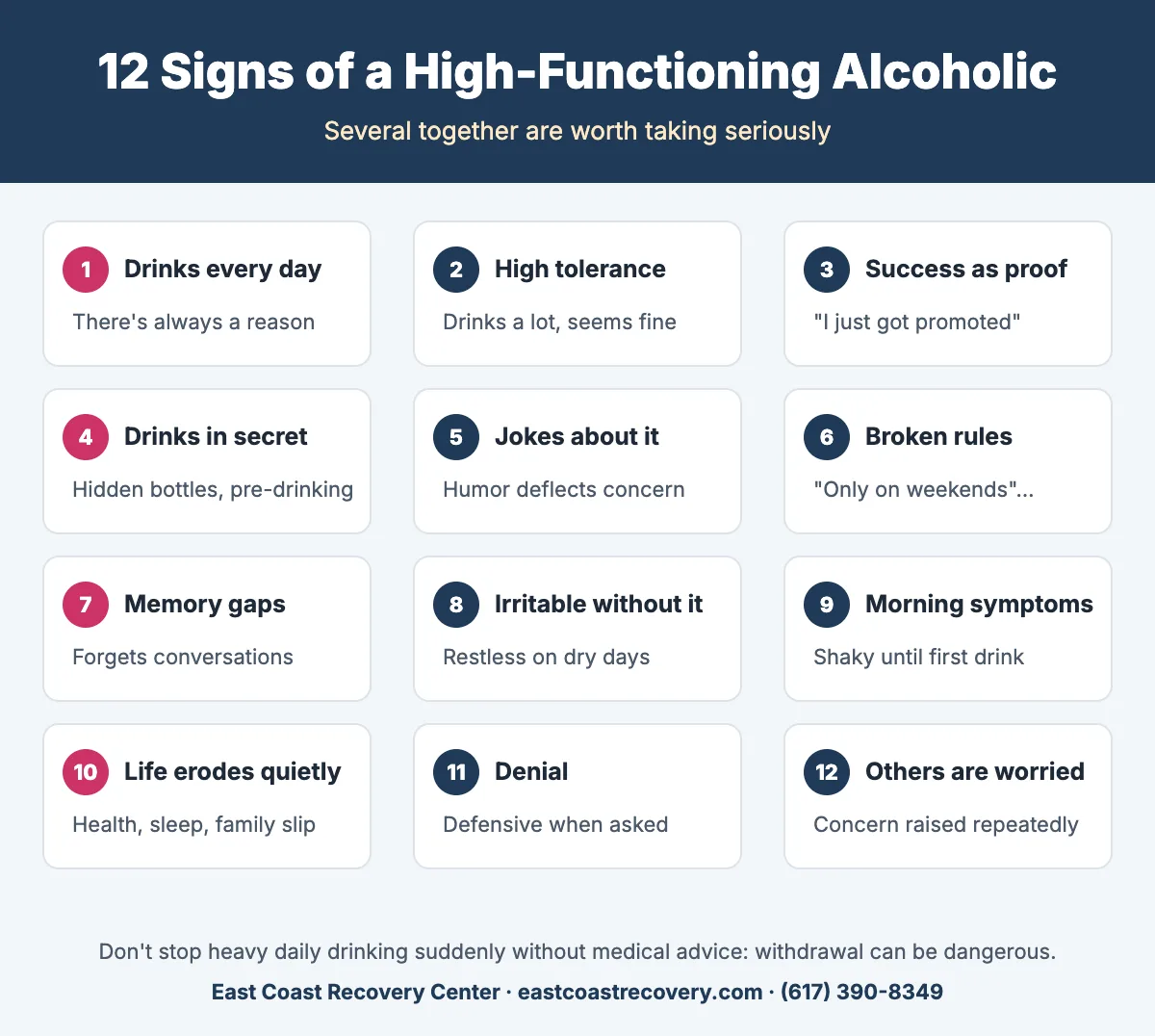
No single sign proves someone has a drinking problem, but several together are worth taking seriously.
- Drinking is part of every routine. A drink after work, with dinner, to unwind, to celebrate, to cope. There’s always a reason.
- High tolerance. They can drink a lot without seeming drunk, and need more than they used to for the same effect.
- Using success as proof. “I can’t have a problem. I just got promoted.” Achievement becomes the defense.
- Drinking alone or in secret. Hidden bottles, a stop at the store on the way home, or pre-drinking before social events.
- Joking about drinking. Humor deflects attention from how much they actually drink.
- Rules that keep getting broken. “Only on weekends” or “never before 5 p.m.,” followed by exceptions.
- Memory gaps. Forgetting conversations or parts of the evening, even when they seemed “fine.”
- Irritability when they can’t drink. Restlessness or anxiety at events, trips, or days without alcohol.
- Morning symptoms. Shakiness, sweating, nausea, or anxiety that eases after a drink, an early sign of physical dependence.
- Compartmentalized life. Work is protected, but sleep, health, hobbies, and relationships quietly erode.
- Denial and defensiveness. Getting angry or changing the subject when drinking comes up.
- Others have voiced concern. A partner, friend, or doctor has said something, more than once.
Many of these overlap with what we cover in how to spot and help a closet alcoholic, since high-functioning drinkers often hide their drinking too.
Why “Functional” Drinking Is Still Dangerous
Being able to keep a job doesn’t protect the body or brain from alcohol. Over time, heavy drinking raises the risk of:
- Liver disease, including fatty liver, alcoholic hepatitis, and cirrhosis
- High blood pressure, heart disease, and stroke
- Several cancers, including breast, liver, esophageal, and colorectal cancer
- Depression, anxiety, and poor sleep (see our guide on high-functioning depression)
- Drunk-driving crashes, injuries, and legal problems
“Functional” is also usually temporary. AUD tends to progress, and the consequences that were held off for years can arrive all at once: a DUI, a health scare, a marriage ending, or a job loss.
Important: people who drink heavily every day should not stop suddenly without medical advice. Alcohol withdrawal can cause seizures and delirium tremens (DTs), which can be life-threatening. A doctor or treatment team can tell you whether medical detox is needed first.
Am I a High-Functioning Alcoholic?
If you’re asking, it’s worth an honest look. Ask yourself, over the past year:
- Have I drunk more, or for longer, than I meant to?
- Have I tried to cut back and couldn’t?
- Do I spend a lot of time drinking or recovering from it?
- Have I kept drinking even though it was causing problems with my health, mood, or relationships?
- Do I need more alcohol to feel the effect, or feel unwell when it wears off?
Answering “yes” to two or more may point to an alcohol use disorder. Only a qualified clinician can diagnose AUD, but you don’t need a diagnosis, or a “rock bottom,” to ask for help.
How to Help a High-Functioning Alcoholic
Because their life looks stable, loved ones often second-guess themselves. These steps tend to work better than confrontation:
- Pick a calm, sober moment. Not during or right after drinking, and not in front of others.
- Use “I” statements and specifics. “I was scared when you drove home from the party” lands better than “You’re an alcoholic.”
- Expect denial. Their success is their evidence. Stay calm and keep the door open.
- Stop covering for them. Calling in sick for them or explaining away missed events protects the drinking, not the person.
- Offer a concrete next step. A doctor’s visit, an assessment, or a call to a treatment center is easier to agree to than “get help.”
- Get support yourself. Al-Anon and family therapy help you set boundaries and avoid burnout.
If conversations keep going nowhere, a structured approach may help. See our step-by-step guide on how to stage an intervention.
Treatment That Fits a Working Life
Many high-functioning drinkers avoid treatment because they assume it means leaving their job for a month. Outpatient care lets you get structured, evidence-based treatment while still living at home. At East Coast Recovery Center in Cohasset, MA, alcohol treatment can include:
- Individual therapy, including CBT and DBT, to understand and change drinking patterns
- Group therapy with peers who know what “functioning” while drinking feels like
- Treatment for co-occurring anxiety, depression, and trauma
- Medication support, such as naltrexone, to reduce cravings when appropriate
- Family therapy to rebuild trust at home
Most major insurance plans cover outpatient rehab. Learn more about insurance coverage for outpatient rehab in Massachusetts, or verify your insurance in a few minutes.
Ready to talk? Call East Coast Recovery Center at (617) 390-8349. The call is confidential, and there’s no obligation.
Frequently Asked Questions
Can a high-functioning alcoholic stop drinking on their own?
Some people can cut back on their own, but many find they can’t stay stopped without support. Anyone who drinks heavily every day should talk to a doctor before quitting, because alcohol withdrawal can be dangerous.
Is a high-functioning alcoholic still an alcoholic?
Yes. If someone meets the criteria for alcohol use disorder, being successful at work doesn’t change the diagnosis or the health risks. “High-functioning” describes how the problem looks from the outside, not how serious it is.
What is the life expectancy of a high-functioning alcoholic?
There’s no single number, but long-term heavy drinking is linked to liver disease, heart disease, several cancers, and accidents, all of which shorten life expectancy. The good news is that many of these risks drop after a person stops drinking.
Do I have to quit my job to go to rehab?
No. Outpatient treatment is designed so you can keep working and living at home while attending therapy sessions on a set schedule.
If you or someone you know is in crisis, call or text 988, or call 911 in an emergency. In Massachusetts, the Substance Use Helpline is available at 800-327-5050.